Masters in San Francisco
Table of Contents
- Why Study Masters in San Francisco?
- Top Universities to Study Masters in San Francisco
- Best Courses to Study Masters in San Francisco
- Eligibility and Admission Requirements to Study Masters in San Francisco
- Cost of Study in San Francisco
- Top Scholarships to Study Masters in San Francisco
- Intakes and Application Timeline for Masters in San Francisco
- How to Apply for Masters in San Francisco
- Student Visa Requirements for Masters in San Francisco
- Work Opportunities While Studying in San Francisco
- Job Opportunity in USA After Studying in San Francisco
- Author's POV
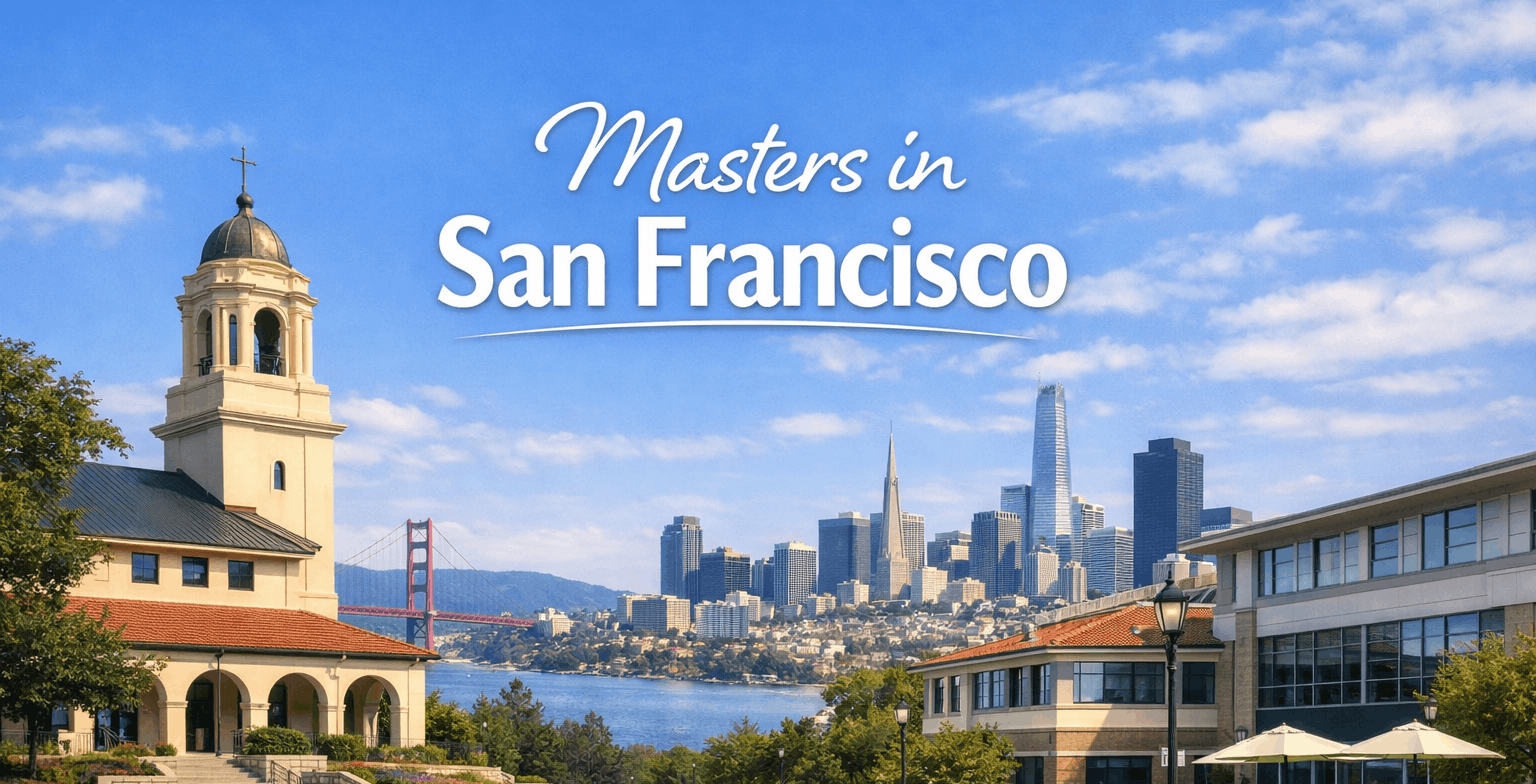
A Masters in San Francisco gives students the opportunity to study in one of the world's leading centres for technology, innovation, healthcare, and entrepreneurship. Home to renowned universities and located close to Silicon Valley, the city offers postgraduate programmes across computer science, business, engineering, public health, biotechnology, finance, and data analytics.
Students benefit from industry-focused learning, research opportunities, and access to global employers through internships and networking events. Whether you are aiming to build a career in tech, healthcare, or business, a Masters in San Francisco combines academic excellence with strong employment prospects in one of the most dynamic cities in the United States.
Key Highlights of Masters in San Francisco:
Key Highlights | Details |
Top Universities | Stanford University, University of California Berkeley, University of San Francisco (USF) |
Top Colleges | Golden Gate University, San Francisco State University (SFSU) |
Course Duration | 1 to 2 years postgraduate |
Popular Fields | Business, Computer Science, Data Science, Finance, Nursing, Public Administration |
Tuition Fees | USD 17,070–90,481/year (approx. INR 16.2L–86.1L) |
Living Expenses | USD 55,200–61,200/year (approx. INR 52.6L–58.3L) |
Post-Study Work Option | OPT (12 months) + STEM OPT (24 months, if eligible) |
Why Study Masters in San Francisco?
Beyond a single university's ranking, San Francisco offers a unique combination of employer proximity, industry access, and career-focused academic options for international students. Choosing to study a Masters in San Francisco means moving into an ecosystem explicitly shaped around the technology and business economy of the wider Bay Area.
1. Direct Access to Silicon Valley's Employer Base: San Francisco sits at the edge of the world's densest technology corridor, with companies like Google, Salesforce, Uber, and Meta actively recruiting from Bay Area university campuses each year.
2. A Genuine Spread of Academic Options: From globally elite research universities to smaller, career-focused colleges, San Francisco offers an institution to match nearly any academic budget or ranking preference, without leaving the same metro region.
3. Strong Graduate Outcomes in Business and Tech: Programmes in business analytics, computer science, and data science consistently produce strong employment outcomes, reflecting direct alignment with the region's dominant industries.
4. A Dense, Walkable City: San Francisco's public transit system covers most of what a graduate student actually needs day to day, reducing dependency on a car in a way many other major US cities can't offer.
5. Post-Study Work Pathway: Graduates can apply for Optional Practical Training (OPT), with an extended 24-month STEM OPT track available for eligible technical and analytics programmes.
6. A Genuinely International Student Body: Universities across San Francisco draw applicants from dozens of countries, creating a multicultural learning and networking environment from day one.
Top Universities to Study Masters in San Francisco
San Francisco features a genuinely wide academic spread, from two of the world's best-ranked universities just outside city limits, to accessible, career-focused institutions inside the city itself. All these institutions hold SEVP certification, meaning international students have full access to Optional Practical Training upon completing their degree.
University | QS World Ranking 2027 | Known For |
Stanford University | #2 globally | Business, Computer Science, Engineering |
University of California, Berkeley | #20 globally | Data Science, Engineering, Public Policy |
University of San Francisco (USF) | #1201-1400 globally | Business, Nursing, Computer Science |
Note: Stanford and Berkeley sit just outside San Francisco's city limits, roughly 30 miles south and 15 miles across the bay respectively, but both are commonly included in "study in San Francisco" searches given their proximity and shared Bay Area job market.
Top Colleges to Study Masters in San Francisco
For many international students, choosing a smaller, career-focused college over a globally ranked research university is a strategic move to maximise return on investment. San Francisco's public and private colleges emphasise practical, industry-aligned skills over heavy academic theory, often at a meaningfully lower tuition cost.
Institution | Key Programme Strengths | Estimated Annual Tuition (USD & INR) |
San Francisco State University (SFSU) | Business, Public Administration, Computer Science | USD 18,000-25,000 (Approx. ₹17.1L-₹23.8L) |
Golden Gate University | Business Analytics, Finance, Taxation, IT Management | USD 17,070+ (Approx. ₹16.2L+) |
Best Courses to Study Masters in San Francisco
The most strategic courses to study in San Francisco reflect the city's dominant high-income sectors: technology, business analytics, finance, and healthcare. For international students, choosing a field here is genuinely useful because programmes across the city's universities connect directly to employers located minutes from campus.
Business and Management Courses
San Francisco's business schools, particularly at USF and Golden Gate University, are known for programmes that combine core management theory with direct exposure to the city's finance and consulting sectors.
Course | University | Approx. Annual Tuition |
MBA (Master of Business Administration) | University of San Francisco | USD 29,430-62,460/year (approx. ₹28.0L-₹59.5L) |
MS Financial Analysis | University of San Francisco | USD 29,430-62,460/year (approx. ₹28.0L-₹59.5L) |
MS Business Analytics | Golden Gate University | USD 17,070+/year (approx. ₹16.2L+) |
MS Accountancy / Taxation | Golden Gate University | USD 17,070+/year (approx. ₹16.2L+) |
Computer Science and Data Science Masters in San Francisco
With San Francisco at the heart of the global technology industry, Masters in Data Science San Francisco programmes and computer science degrees remain among the most popular choices for international students. The University of San Francisco Masters in Computer Science is particularly well known for its industry-focused curriculum.
Course | University | Approx. Annual Tuition |
MS Computer Science | University of San Francisco | USD 29,430-62,460/year (approx. ₹28.0L-₹59.5L) |
MS Data Science | University of San Francisco | USD 29,430-62,460/year (approx. ₹28.0L-₹59.5L) |
MS Information Technology Management | Golden Gate University | USD 17,070+/year (approx. ₹16.2L+) |
Health Sciences and Nursing Courses
Nursing and public health programmes consistently rank among the most popular graduate options at USF specifically, reflecting strong regional demand across the Bay Area's dense hospital and healthcare network.
Course | University | Approx. Annual Tuition |
MSN (Master of Science in Nursing) | University of San Francisco | USD 29,430-62,460/year (approx. ₹28.0L-₹59.5L) |
DNP (Doctor of Nursing Practice) | University of San Francisco | USD 29,430-62,460/year (approx. ₹28.0L-₹59.5L) |
Master of Public Health (MPH) | University of San Francisco | USD 29,430-62,460/year (approx. ₹28.0L-₹59.5L) |
Eligibility and Admission Requirements to Study Masters in San Francisco
Admission requirements in San Francisco shift quite a bit depending on which tier of university you're targeting, since Stanford and Berkeley's selectivity looks nothing like the more accessible process at USF, SFSU, or Golden Gate University.
Academic Requirements
Universities in San Francisco evaluate candidates on prior academic performance, generally converted to a 4.0 GPA scale, alongside programme-specific prerequisites.
Institution Tier | Minimum Academic Requirement | Key Notes |
Highly Selective (Stanford, Berkeley) | Exceptional undergraduate GPA, generally top of class, plus strong research or professional profile | Extremely competitive; often requires GRE/GMAT for specific programmes |
Mid-Tier (USF) | GPA around 3.0/4.0 for most graduate programmes | Holistic review; STEM prerequisites checked closely for technical courses |
Accessible (SFSU, Golden Gate University) | GPA around 3.0/4.0; conditional admission possible slightly below this | Highly accessible entry criteria; GGU allows conditional admission with department approval |
English Language Requirements
International applicants whose first language isn't English must submit an approved test score, with minimum requirements varying by university and specific programme.
Institution | IELTS Academic | TOEFL iBT | Duolingo |
University of San Francisco | 6.5 overall (programme-specific) | 79-88+ | 105-110 |
San Francisco State University | 6.0-6.5 overall | 80+ | Accepted, varies |
Golden Gate University | 6.5 overall | 79 | 110 |
Other Application Documents Required
Gathering a complete application packet early is essential to secure both your admission offer and your subsequent F-1 visa documentation.
Academic Transcripts: Official transcripts and degree certificates from all previously attended institutions, with WES or equivalent evaluation for foreign degrees where required
Statement of Purpose (SOP): A personalised letter explaining your academic background, career goals, and why San Francisco specifically fits your long-term plans
Letters of Recommendation (LORs): Two to three letters from academic or professional referees who can speak to your readiness for graduate study
Updated Resume (CV): Highlighting relevant internships, research, or work experience
Financial Documents: Proof of funds sufficient to cover tuition and living costs, required for your I-20 and later your F-1 visa application
Cost of Study in San Francisco
One of the more practical considerations when choosing a Masters in San Francisco is the significant tuition gap between the city's elite research universities and its more accessible, career-focused colleges. That gap matters a great deal when budgeting across a one- or two-year programme.
Tuition Fees at San Francisco Universities
University | Tuition Structure | Approx. Annual Tuition (USD/INR) |
University of San Francisco | USD 1,635-1,735/unit | USD 29,430-62,460 (INR 28.0L-59.5L) |
San Francisco State University | Base tuition + non-resident surcharge | USD 18,000-25,000 (INR 17.1L-23.8L) |
Golden Gate University | USD 1,090/unit | USD 17,070+ (INR 16.2L+) |
Cost of Living in San Francisco
San Francisco is consistently ranked among the most expensive US cities to live in, and Numbeo's most recent data, updated in July 2026, confirms this remains true, driven mostly by housing.
Expense Category | Approx. Monthly Cost (USD) | INR Value |
Cost of living, single person, excluding rent (Numbeo) | USD 1,586 | INR 1.51 lakh |
1-Bedroom Apartment (general market estimate) | USD 3,000-3,500 | INR 2.86L-3.33L |
Basic Utilities | USD 255 | INR 24,300 |
Groceries | USD 738 | INR 70,300 |
Total Annual Living Cost | USD 55,200-61,200 | INR 52.6L-58.3L |
Source: Numbeo
Top Scholarships to Study Masters in San Francisco
Offsetting tuition costs in San Francisco is genuinely more limited for international students than for domestic ones, since most of the largest need-based programmes, like FAFSA-linked aid, are restricted to US citizens and permanent residents. That said, a real set of merit and institutional awards remains open to international applicants.
Scholarship / Award Name | Eligible Institution | Coverage |
USF Merit Scholarships | University of San Francisco | Renewable each year for up to four years, based on GPA in core academic subjects; tuition only |
SFSU International Scholarship | San Francisco State University | Awarded on academic achievement, financial need, and community involvement |
Robert E. Collins Endowed Scholarship | San Francisco State University | USD 2,000 (approx. ₹1.9 lakh), open to all nationalities |
GGU Institutional Scholarships | Golden Gate University | Automatically considered during admissions, no separate application needed |
Intakes and Application Timeline for Masters in San Francisco
Most San Francisco universities follow the standard US academic calendar, with Fall as the primary intake and a more limited Spring option at select institutions. Fall remains the most practical entry point for a Masters in San Francisco, offering the widest programme selection, the strongest scholarship availability, and the best alignment with internship and co-op cycles at major Bay Area employers.
Intake | Programme Start | Application Timeline |
Fall Intake (Main) | August/September | Applications typically open 8-12 months prior; most deadlines December to April |
Spring Intake (Limited) | January | Available for select programmes; narrower course selection |
Summer Intake (Limited) | May/June | Available at some institutions, including Golden Gate University, for accelerated programmes |
How to Apply for Masters in San Francisco
Applying for a Masters in San Francisco is straightforward but requires good organisation, since several requirements, academic documents, English test scores, and visa paperwork, all need to come together within a fairly tight window.
Step | What to Do |
Step 1: Shortlist Universities | Compare Stanford, Berkeley, USF, SFSU, and Golden Gate University based on ranking tier, tuition, and admission competitiveness |
Step 2: Check Eligibility | Review GPA requirements, English test minimums, and any GRE/GMAT prerequisites |
Step 3: Prepare Language Tests | Sit IELTS, TOEFL, or Duolingo at least three months before application deadlines |
Step 4: Compile Documents | Gather transcripts, SOP, LORs, CV, and passport |
Step 5: Submit Application | Apply through each university's official admissions portal; pay application fees |
Step 6: Apply for Scholarships | Submit scholarship applications alongside or immediately after your admissions application |
Step 7: Accept Offer | Confirm your place by accepting the offer and paying any required deposit |
Step 8: Receive I-20 and Apply for F-1 Visa | Once financial proof is confirmed, your university issues Form I-20 to begin your visa application |
Step 9: Arrange Pre-Departure | Book accommodation, organise health insurance, and prepare travel documents |
Student Visa Requirements for Masters in San Francisco
International students admitted to a Masters in San Francisco must apply for an F-1 Student Visa, issued by the US Department of State. This is the standard visa route for all full-time international students enrolled at SEVP-approved US institutions, covering Stanford, Berkeley, USF, SFSU, and Golden Gate University alike.
Requirement | Detail | Approx. Amount |
Form I-20 | Issued by your SEVP-certified university after admission and financial proof | Required |
Proof of Financial Capacity | Tuition plus living costs for the first year | USD 30,000-90,481/year (approx. ₹28.6L-₹86.1L) |
SEVIS I-901 Fee | Paid online at FMJfee.com before your visa interview | USD 350 (approx. ₹33,300) |
DS-160 / MRV Visa Fee | Nonimmigrant visa application processing fee | USD 185 (approx. ₹17,600) |
Medical Examination | Required for applicants from certain countries | — |
English Test Scores | IELTS, TOEFL, or Duolingo as required by your programme | — |
Academic Documents | Transcripts, degree certificates, test scores | — |
Note: After completing their degree, eligible graduates can apply for Optional Practical Training (OPT), allowing up to 12 months of work authorisation in a role related to their field of study, extended to 24 additional months for graduates of STEM-designated programmes.
Work Opportunities While Studying in San Francisco
International students on an F-1 visa can work on campus for up to 20 hours per week during the academic term, and full-time during scheduled breaks, without needing separate authorisation. San Francisco's job market for students is genuinely broader than people expect, spanning tech startups, retail, hospitality, and on-campus research roles.
Role | Work Limit | Approx. Hourly Rate |
Research Assistant | 20 hours/week during term | USD 20-28/hour (approx. ₹1,900-₹2,665/hour) |
Teaching Assistant | 20 hours/week during term | USD 22-30/hour (approx. ₹2,095-₹2,856/hour) |
Tech Internship (CPT) | Programme-specific; often full-time | USD 25-45/hour (approx. ₹2,380-₹4,284/hour) |
Campus or Admin Support | 20 hours/week during term | USD 17-22/hour (approx. ₹1,618-₹2,095/hour) |
Retail or Hospitality | 20 hours/week during term | USD 17-20/hour (approx. ₹1,618-₹1,904/hour) |
Note: Curricular Practical Training (CPT) allows work tied directly to your degree, such as an internship, with your university's approval. Given San Francisco's dense startup and tech ecosystem, CPT placements here are genuinely more accessible than in most other US cities.
Job Opportunity in USA After Studying in San Francisco
Job opportunities after a Masters in San Francisco are concentrated heavily in technology, financial services, and healthcare, with the wider Bay Area economy pulling salaries well above the US national average across nearly every business and technical role.
Average salary in USA after studying in San Francisco is particularly strong for computer science, data analytics, and business graduates, given the direct proximity of major employers across all three fields.
Job Role | Approx. Annual Salary (USD) | INR Value |
Business Analyst | USD 102,735-162,021 | Rs. 97.8L-154.3L |
Analyst (general) | USD 105,428-166,721 | Rs. 100.4L-158.7L |
Senior Business Analyst | USD 151,375-215,900 | Rs. 144.1L-205.5L |
Software Developer | USD 193,279 | Rs. 184.0L |
Software Engineer | USD 234,175 | Rs. 222.9L |
Source: Glassdoor
Author's POV
A Masters in San Francisco is a smart choice if your priority is building a career in technology, healthcare, finance, or entrepreneurship rather than simply studying in a famous city. The biggest advantage isn't the skyline or the university name alone. It's the access to one of the world's strongest job markets, where startups, global tech companies, and research organisations actively recruit skilled graduates.
That said, not every university in San Francisco offers the same experience. Institutions differ significantly in rankings, tuition fees, research opportunities, and employer connections, so choosing the right programme matters far more than choosing the city itself. A higher tuition fee doesn't automatically translate into better career outcomes if the course doesn't align with your goals. Focus on factors such as internships, alumni network, industry partnerships, and graduate employment. If you're prepared for San Francisco's higher living costs and can make the most of its professional ecosystem, a Masters in San Francisco can deliver strong long-term career value.
Planning to pursue Masters in San Francisco ? Speak with our study abroad experts for personalised guidance.