Masters in Public Health in USA
Table of Contents
- Top Universities for Masters in Public Health in USA
- Best Courses and Specialisations in Masters in Public Health in USA
- Eligibility and Admission Requirements for Masters in Public Health in USA
- Cost of Masters in Public Health in USA
- Scholarships for Masters in Public Health in USA
- Intakes and Application Timeline for Masters in Public Health in USA
- How to Apply for Masters in Public Health in USA
- Student Visa Requirements for Masters in Public Health in USA
- Work Opportunities While Studying Masters in Public Health in USA
- Career Opportunities After Masters in Public Health in USA
- Conclusion
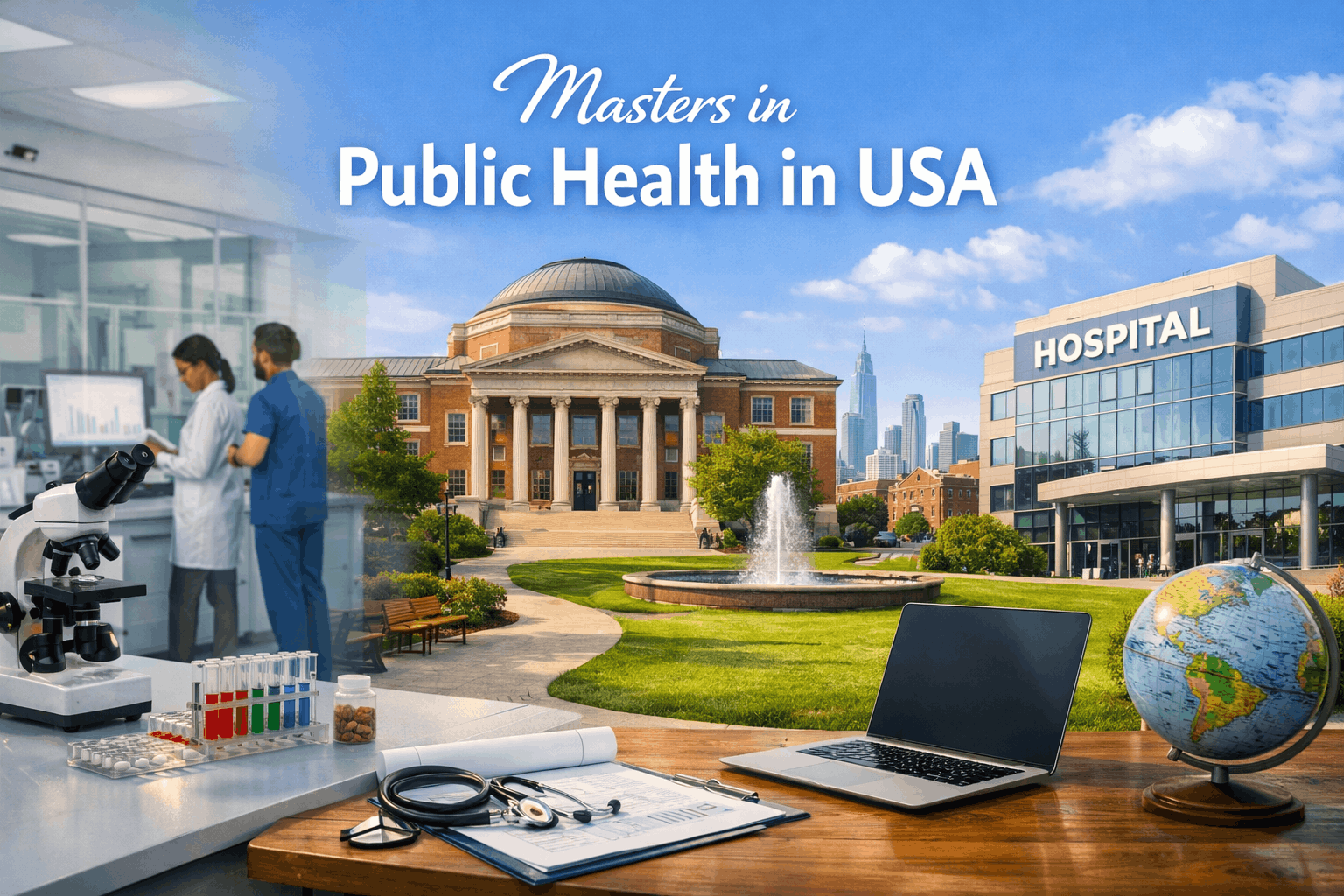
A Masters in Public Health in USA is a 1 to 2-year graduate degree focused on community health, disease prevention, epidemiology, biostatistics, and health policy. Most programmes are housed within CEPH-accredited schools of public health and are structured to combine academic rigour with applied fieldwork through a required practicum or capstone. Many Masters in Public Health in USA programmes carry STEM designation, allowing international graduates to extend post-study work authorisation beyond the standard 12-month OPT period. With world-class research universities, a vast public health infrastructure, and strong employer demand, USA remains a leading destination for public health education in 2026.
Key Highlights: Masters in Public Health in USA
Key Point | Details |
Programme Duration | 1.5 to 2 years full-time |
Degree Awarded | Master of Public Health (MPH) or MS in Public Health |
Course Type | CEPH-accredited; thesis or course-based depending on university |
Approx. Annual Tuition Fee | USD 20,000–60,000 (approx. Rs. 16.6L–Rs. 49.8L) |
Top Universities | Johns Hopkins, Harvard, Columbia, University of Michigan, UCLA |
Core Focus Areas | Epidemiology, Biostatistics, Health Policy, Environmental Health, Global Health |
Post-Study Work Option | OPT 12 months plus STEM OPT 24 months if STEM-designated |
Career Outcomes | Epidemiologist, Health Policy Analyst, Public Health Officer, Global Health Consultant, Biostatistician |
Scholarship Options | Fulbright, CDC fellowships, university merit awards |
Top Universities for Masters in Public Health in USA
The USA has some of the most globally recognised schools of public health, many of which are embedded within research-intensive universities with direct links to government health agencies, hospitals, and international health organisations. Programme reputation, CEPH accreditation, research output, and career support should all be compared before shortlisting.
University | QS World Ranking 2026 | Approx. Annual Tuition |
Johns Hopkins University (Bloomberg School) | #24 | USD 55,000–60,000 (approx. Rs. 45.7L–Rs. 49.8L) |
Harvard University (T.H. Chan School) | #5 | USD 55,000–62,000 (approx. Rs. 45.7L–Rs. 51.5L) |
Columbia University (Mailman School) | #33 | USD 52,000–58,000 (approx. Rs. 43.2L–Rs. 48.1L) |
University of Michigan | #44 | USD 30,000–45,000 (approx. Rs. 24.9L–Rs. 37.4L) |
UCLA (Fielding School) | #29 | USD 28,000–42,000 (approx. Rs. 23.2L–Rs. 34.9L) |
University of North Carolina Chapel Hill | #97 | USD 25,000–38,000 (approx. Rs. 20.8L–Rs. 31.5L) |
Boston University (School of Public Health) | #111 | USD 30,000–45,000 (approx. Rs. 24.9L–Rs. 37.4L) |
Emory University (Rollins School) | #131 | USD 35,000–48,000 (approx. Rs. 29.1L–Rs. 39.8L) |
University of Washington | #85 | USD 22,000–38,000 (approx. Rs. 18.3L–Rs. 31.5L) |
George Washington University | #551–560 | USD 30,000–44,000 (approx. Rs. 24.9L–Rs. 36.5L) |
Best Courses and Specialisations in Masters in Public Health in USA
Choosing the right specialisation within an MPH programme shapes both the academic experience and post-graduation career direction. USA public health programmes offer a broad range of concentration areas, and students should align their choice with long-term career goals, research interests, and the specific strengths of their chosen institution.
Core MPH Curriculum
The core curriculum across most CEPH-accredited MPH programmes in USA builds foundational competency in research methods, population health, and health systems management. This base applies regardless of specialisation and prepares students for both applied practice and research-oriented roles in public health.
Core Subject Area | What It Covers |
Epidemiology | Disease surveillance, outbreak investigation, population-level data analysis, causal inference |
Biostatistics | Statistical methods for public health research, quantitative analysis, data interpretation |
Health Policy and Management | Healthcare systems, policy development, health economics, programme evaluation |
Environmental Health Sciences | Environmental risk factors, exposure assessment, toxicology, regulatory frameworks |
Social and Behavioural Sciences | Health determinants, community health, behaviour change models, health communication |
Global Health | International health systems, infectious disease control, humanitarian response, health equity |
Popular Specialisations in Masters in Public Health in USA
Specialisations allow students to concentrate coursework and applied projects around a specific area of public health practice. Selecting a specialisation that aligns with USA public health priorities and labour market demand strengthens post-graduation employment prospects considerably.
Specialisation | Focus Areas |
Epidemiology and Biostatistics | Disease modelling, surveillance systems, clinical trial design, statistical computing |
Global Health | International development, infectious disease, humanitarian response, health equity |
Health Policy and Management | Policy analysis, health administration, programme planning, systems thinking |
Environmental and Occupational Health | Environmental toxicology, climate and health, occupational exposure, risk assessment |
Community Health and Behaviour | Community-based health, health promotion, social determinants, intervention design |
Health Informatics and Digital Health | Health data systems, electronic records, public health surveillance technology, AI in health |
Eligibility and Admission Requirements for Masters in Public Health in USA
Admission to a Masters in Public Health in USA requires a recognised undergraduate degree, English language proficiency, and in some cases GRE scores and relevant work or research experience. Requirements vary by university and programme tier, but most CEPH-accredited institutions follow a broadly consistent admissions framework for international applicants.
Academic Requirements
A four-year undergraduate degree in a relevant field such as life sciences, social sciences, health sciences, nursing, or medicine is typically expected. Several top programmes accept graduates from other disciplines provided they demonstrate quantitative readiness and a clear rationale for pursuing public health at graduate level.
University Tier | Academic Expectations |
Top Universities (Johns Hopkins, Harvard, Columbia) | Four-year bachelor's degree; strong GPA of 3.5 out of 4.0 or above; research or health sector experience preferred |
Mid-Tier Universities (Boston University, Emory, UNC) | Bachelor's degree with GPA of 3.0 to 3.5; relevant background in health or social sciences advantageous |
Affordable Universities (UW, GWU) | Recognised undergraduate degree; GPA requirements vary; broader background acceptance at select programmes |
English Language Requirements
International students from non-English speaking countries must submit English language test scores as part of the admissions process. Waivers may apply for students who completed their prior degree entirely in English at a recognised institution.
University Tier | IELTS Academic | TOEFL iBT |
Top Universities (Johns Hopkins, Harvard, Columbia) | 7.0 or above | 100 or above |
Mid-Tier Universities (Boston University, Emory) | 6.5 to 7.0 | 90 to 100 |
Affordable Universities (UW, GWU) | 6.5 | 80 to 90 |
GRE and Other Admission Requirements
GRE scores are required or recommended at several US public health programmes, particularly at top-tier universities. Supporting documents are assessed holistically alongside academic performance and test scores, and a strong statement of purpose carries significant weight in competitive admissions.
Requirement | Detail |
GRE Scores | Required or recommended at select universities; check individual programme pages |
Statement of Purpose | Outlines research interests, career goals, and reasons for choosing the programme |
Letters of Recommendation | Two to three academic or professional references |
CV or Resume | Academic background, work experience, research, and volunteer history |
Relevant Experience | Health sector work, research, or community service; valued but not mandatory at all universities |
Cost of Masters in Public Health in USA
The total cost of a Masters in Public Health in USA includes tuition fees and living expenses, both of which vary considerably by university tier, city, and programme length. USA is generally more expensive than Canada or Australia for graduate study, but strong scholarship options, assistantships, and the post-study work window can offset costs for well-prepared students.
Tuition Fees for Masters in Public Health in USA
Tuition fees for MPH programmes in USA differ significantly between private and public universities and between in-state and out-of-state or international students. Students should always verify current fees on the official university website before applying.
University | Approx. Annual Tuition (International Students) | INR Value |
Johns Hopkins Bloomberg School | USD 55,000–60,000/year | Rs. 45.7L–Rs. 49.8L/year |
Harvard T.H. Chan School | USD 55,000–62,000/year | Rs. 45.7L–Rs. 51.5L/year |
Columbia Mailman School | USD 52,000–58,000/year | Rs. 43.2L–Rs. 48.1L/year |
Emory Rollins School | USD 35,000–48,000/year | Rs. 29.1L–Rs. 39.8L/year |
Boston University | USD 30,000–45,000/year | Rs. 24.9L–Rs. 37.4L/year |
University of Michigan | USD 30,000–45,000/year | Rs. 24.9L–Rs. 37.4L/year |
University of Washington | USD 22,000–38,000/year | Rs. 18.3L–Rs. 31.5L/year |
Cost of Living in USA for MPH Students
Living costs in USA vary significantly by city. Public health school hubs like Boston, New York, and Los Angeles carry higher expenses than mid-size cities like Chapel Hill, Ann Arbor, or Seattle. Students should factor in accommodation, food, transport, health insurance, and personal expenses when building a realistic total budget.
Expense Category | Major Metro Cities | Mid-Size or College Towns |
Accommodation | USD 1,500–2,800/month (approx. Rs. 1.24L–Rs. 2.32L) | USD 800–1,400/month (approx. Rs. 66,400–Rs. 1.16L) |
Food and Groceries | USD 400–700/month (approx. Rs. 33,200–Rs. 58,100) | USD 250–450/month (approx. Rs. 20,750–Rs. 37,350) |
Transport | USD 100–250/month (approx. Rs. 8,300–Rs. 20,750) | USD 80–150/month (approx. Rs. 6,640–Rs. 12,450) |
Health Insurance | USD 150–300/month (approx. Rs. 12,450–Rs. 24,900) | USD 100–200/month (approx. Rs. 8,300–Rs. 16,600) |
Books and Personal Expenses | USD 200–400/month (approx. Rs. 16,600–Rs. 33,200) | USD 150–300/month (approx. Rs. 12,450–Rs. 24,900) |
Total Annual Living Cost | USD 20,000–32,000 (approx. Rs. 16.6L–Rs. 26.6L) | USD 14,000–22,000 (approx. Rs. 11.6L–Rs. 18.3L) |
Scholarships for Masters in Public Health in USA
Several official scholarship and funding programmes support international students pursuing a Masters in Public Health in USA. Options range from government-funded awards to university-specific merit fellowships and federal agency programmes. Students should begin scholarship research at least 12 months before their intended intake, as competitive awards like Fulbright require preparation well ahead of application deadlines.
Scholarship | Eligibility | Coverage |
Fulbright Foreign Student Program | Bachelor's degree from a recognised institution; strong academic record; leadership potential; commitment to return home after programme completion | Full or partial tuition, monthly living stipend, return airfare, health insurance |
CDC Public Health Fellowships | Enrolled in or admitted to a CEPH-accredited public health programme; specific eligibility varies by fellowship track | Stipend, training support, and in some cases tuition assistance |
NIH Research Training Grants | Enrolled in a health research graduate programme at a CEPH-accredited institution; strong research proposal in an eligible health area | Stipend plus tuition support; varies by grant and department |
ASPPH Scholarships and Awards | Enrolled in a CEPH-accredited MPH programme; specific criteria vary by award category | Financial awards and academic recognition; amounts vary by programme |
Johns Hopkins Bloomberg School Fellowships | Admitted to an MPH programme at Bloomberg School; strong academic standing; merit reviewed at admission; no separate application required | Partial to full tuition support; varies by fellowship |
Harvard T.H. Chan School Merit Awards | Admitted to an MPH programme at Harvard Chan School; strong academic performance; merit and need assessed at admission | Partial tuition reduction; varies by award |
Graduate Teaching and Research Assistantships | Strong academic performance; availability determined by school and department; often awarded in second year | Partial tuition reduction plus stipend of USD 1,000–2,500/month (approx. Rs. 83,000–Rs. 2.07L) |
Intakes and Application Timeline for Masters in Public Health in USA
MPH programmes in USA primarily follow a single annual intake cycle aligned with the academic year. Most schools use a rolling or round-based admissions system within this cycle, and applying early consistently improves both admission outcomes and scholarship consideration.
Intake | Programme Start | Application Timeline |
Fall Intake (Main) | August to September | Applications open September prior year; deadlines typically December to March |
Spring Intake (Limited) | January | Available at select universities only; applications open June to September |
Note:
· The Fall intake is the primary entry point for MPH programmes in USA and offers the widest course, specialisation, and funding availability.
· Most competitive scholarships and fellowship deadlines fall between December and February.
· Spring intake is available at a limited number of universities and is not standard for public health programmes.
How to Apply for Masters in Public Health in USA
The application process for a Masters in Public Health in USA involves multiple sequential steps, each with its own timeline. Test preparation, document compilation, financial proof, and visa processing all overlap during peak periods, which makes starting early the most practical advice for any prospective applicant.
Step | What to Do |
Step 1: Shortlist Universities | Select based on CEPH accreditation, specialisation, fees, location, and scholarship availability |
Step 2: Check Eligibility | Review GPA requirements, English score thresholds, GRE policies, and document requirements |
Step 3: Prepare for Tests | Sit GRE if required; take IELTS or TOEFL well in advance of deadlines |
Step 4: Compile Documents | Gather transcripts, SOP, two to three LORs, CV, and passport |
Step 5: Submit Applications | Apply via each university's official admissions portal; pay application fees |
Step 6: Track Application Progress | Monitor for conditional or unconditional offer letters through the portal |
Step 7: Accept Offer and Pay Deposit | Confirm place by accepting the offer and submitting the enrolment deposit |
Step 8: Receive I-20 Form | Submit financial proof to obtain the I-20 form for visa processing |
Step 9: Apply for F-1 Visa | Complete DS-160, pay SEVIS fee, schedule and attend the visa interview |
Student Visa Requirements for Masters in Public Health in USA
International students enrolling in a Masters in Public Health in USA must apply for an F-1 Student Visa. The university issues Form I-20 after confirming admission and financial eligibility, and this document is the mandatory starting point for the visa process. Students should begin visa preparation immediately after receiving the I-20 to avoid delays before the programme start date.
Requirement | Detail | Approx. Amount |
Confirmed Admission | From a SEVP-approved US university | Required |
Form I-20 | Issued by the university after financial verification | Required |
DS-160 Application | Online non-immigrant visa application | Required |
SEVIS Fee | Student and Exchange Visitor Information System fee | USD 350 (approx. Rs. 29,050) |
Visa Application Fee | MRV fee paid before the interview | USD 185 (approx. Rs. 15,355) |
Proof of Funds | Tuition plus living costs for first year | USD 14,000–32,000/year (approx. Rs. 11.6L–Rs. 26.6L) |
English Test Scores | IELTS, TOEFL, or accepted equivalent | University-specific |
Academic Documents | Transcripts, degree certificates, test scores | Required |
Work Opportunities While Studying Masters in Public Health in USA
F-1 visa holders enrolled in a Masters in Public Health in USA may work up to 20 hours per week on-campus during the academic term. Off-campus employment is only permitted through authorised channels such as CPT or OPT. On-campus work helps students manage day-to-day expenses and build relevant professional experience within the university environment.
Role | Work Limit | Approx. Hourly Rate |
Research Assistant | 20 hours/week during term | USD 18–28/hour (approx. Rs. 1,494–Rs. 2,324/hour) |
Teaching Assistant | 20 hours/week during term | USD 20–30/hour (approx. Rs. 1,660–Rs. 2,490/hour) |
Public Health Programme Support | 20 hours/week during term | USD 16–24/hour (approx. Rs. 1,328–Rs. 1,992/hour) |
Campus or Admin Support | 20 hours/week during term | USD 15–20/hour (approx. Rs. 1,245–Rs. 1,660/hour) |
Library or Student Services | 20 hours/week during term | USD 15–22/hour (approx. Rs. 1,245–Rs. 1,826/hour) |
Note: Part-time earnings help with day-to-day costs but should not replace the need to arrange full tuition and living funds before travelling. Students must maintain satisfactory academic standing to retain work rights during the programme.
Career Opportunities After Masters in Public Health in USA
Graduates of a Masters in Public Health in USA are well positioned for roles across government health agencies, research institutions, hospitals, international organisations, NGOs, and consulting firms. The USA public health sector is one of the largest and most resource-intensive globally, creating consistent demand for qualified MPH graduates at federal, state, and local levels.
Job Role | Field | Approx. Annual Salary |
Epidemiologist | CDC, state health departments, research institutions | USD 70,000–110,000 (approx. Rs. 58.1L–Rs. 91.3L) |
Public Health Officer | Federal and state agencies, city health departments | USD 65,000–100,000 (approx. Rs. 53.95L–Rs. 83L) |
Health Policy Analyst | Government, think tanks, hospital systems | USD 65,000–105,000 (approx. Rs. 53.95L–Rs. 87.15L) |
Global Health Consultant | NGOs, WHO affiliates, international organisations | USD 70,000–120,000 (approx. Rs. 58.1L–Rs. 99.6L) |
Biostatistician | Research institutions, pharmaceutical companies, CDC | USD 80,000–120,000 (approx. Rs. 66.4L–Rs. 99.6L) |
Environmental Health Officer | EPA, state agencies, municipal health departments | USD 65,000–95,000 (approx. Rs. 53.95L–Rs. 78.85L) |
Health Promotion Specialist | Public health units, community organisations, NGOs | USD 55,000–85,000 (approx. Rs. 45.65L–Rs. 70.55L) |
Conclusion
A Masters in Public Health in USA offers international students direct access to one of the world's most advanced public health systems, combined with strong academic credentials from CEPH-accredited institutions. The programme prepares graduates for leadership roles across government agencies, research institutions, global health organisations, and consulting firms, with post-study work rights through OPT and STEM OPT giving graduates a meaningful window to build a US-based career.
The total cost includes tuition of approximately USD 20,000–62,000 per year (approx. Rs. 16.6L–Rs. 51.5L per year) and living expenses of approximately USD 14,000–32,000 per year (approx. Rs. 11.6L–Rs. 26.6L per year).
Planning to pursue a Masters in Public Health in USA? Speak with our study abroad experts for personalised guidance.