Masters in Chicago
Table of Contents
- Why Study Masters in Chicago?
- Best Universities in Chicago for Masters
- Top Masters Courses in Chicago
- Eligibility and Admission Requirements to Study Masters in Chicago
- Cost of Study in Chicago
- Top Scholarships to Study Masters in Chicago
- How to Apply to Study Masters in Chicago
- Student Visa Requirements for Masters in Chicago
- Job Opportunity in USA After Studying Masters in Chicago
- Author's POV
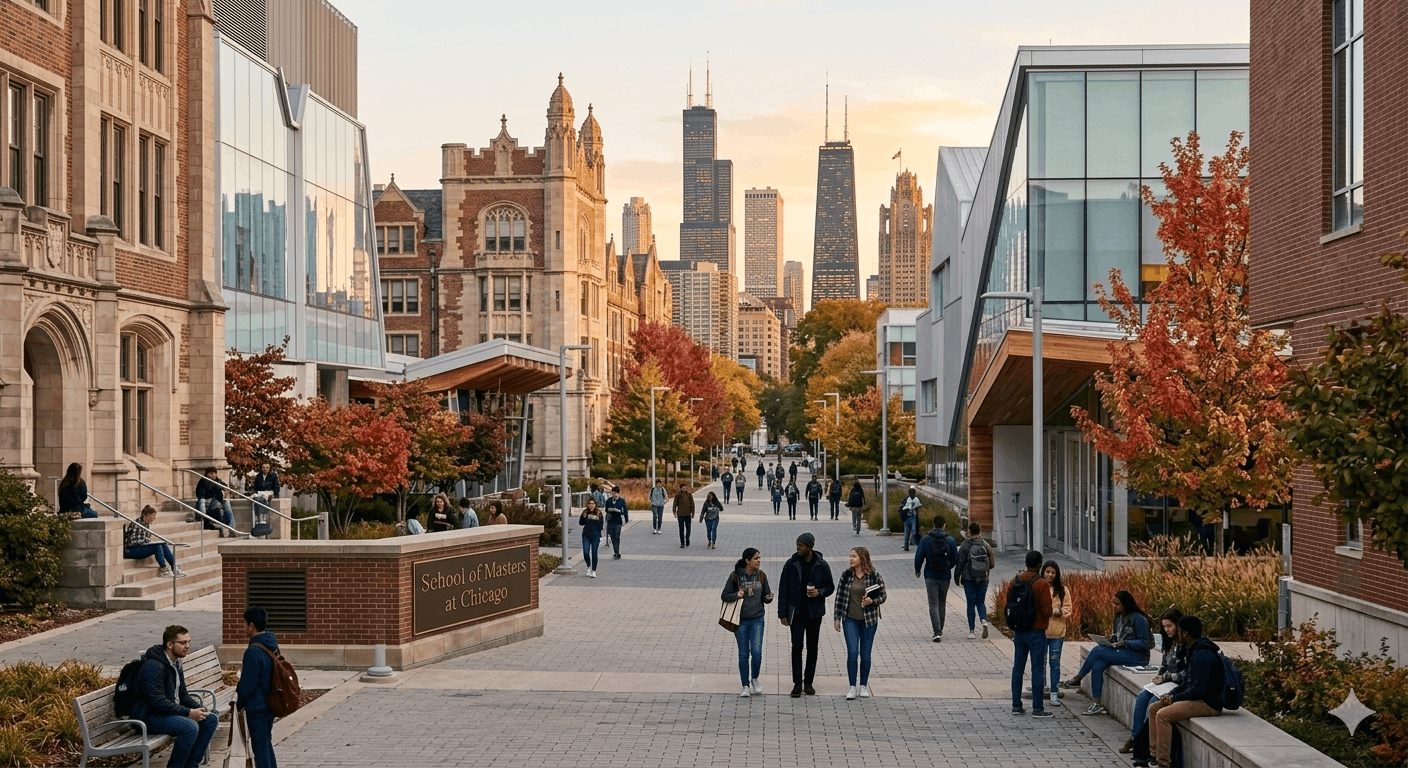
A Masters in Chicago gives international students the opportunity to study in one of the United States' leading academic and business hubs. Home to globally recognised universities, Chicago offers postgraduate programmes across business, engineering, computer science, data science, public policy, healthcare, and the arts. The city combines world-class education with a thriving economy, giving students access to internships, research opportunities, and connections with leading employers. Whether you're looking to build technical expertise, advance your career, or pursue research, a Masters in Chicago provides the academic foundation and industry exposure needed to succeed in today's competitive global job market.
Key Highlights of Masters in Chicago:
Key Highlights | Details |
Best Universities in Chicago for Masters | University of Chicago, Northwestern University |
Colleges in Chicago for Masters | Chicago State University, School of the Art Institute of Chicago (SAIC), Adler University |
Course Duration | 9 to 24 months postgraduate |
Popular Fields | Analytics, Computer Science, Finance, Psychology, Interior Architecture |
Tuition Fees | USD 12,150–114,912 (approx. INR 11.6L–109.5L) |
Living Expenses | USD 15,300–18,000/year (approx. INR 14.6L–17.1L) |
Post-Study Work Option | OPT (12 months) + STEM OPT (24 months, if applicable) |
Language of Instruction | English |
Why Study Masters in Chicago?
Beyond a single university's ranking, Chicago offers international students a genuinely wide academic spread within one metro area, spanning globally elite research institutions and considerably more accessible, career-focused colleges.
1. Two Globally Elite Universities: The University of Chicago and Northwestern both sit comfortably within the world's top 50 in the QS World University Rankings 2027, giving Chicago a rare concentration of elite institutions few other US cities can match.
2. A Dense Corporate and Finance Employer Base: Chicago is headquarters to major firms including McDonald's, Boeing, United Airlines, and Kraft Heinz, alongside an active finance, consulting, and growing tech sector.
3. Genuinely Wide Programme Diversity: From the University of Chicago's Applied Data Science programme to Chicago State University's considerably more affordable computer science route and SAIC's NAAB-accredited Interior Architecture track, Chicago covers nearly every field at multiple price points.
4. Lower Cost of Living Than Coastal Cities: Chicago runs meaningfully cheaper than New York or San Francisco, stretching your budget further across a full graduate programme.
5. Strong Psychology and Mental Health Training Base: With institutions like Adler University and Loyola Chicago offering dedicated psychology Masters routes, Chicago has genuine depth in clinical and counselling psychology training.
6. Post-Study Work Access: International graduates can apply for Optional Practical Training (OPT), extended to 24 additional months for STEM-designated degrees, common across Chicago's analytics and computer science programmes.
Best Universities in Chicago for Masters
The best universities in Chicago for masters split into two clear tiers: two globally elite, extremely selective research universities, and a genuinely wide second tier of accessible, specialised institutions covering everything from computer science to fine arts.
University | QS World Ranking 2027 | Known For |
University of Chicago | #24 globally | Analytics, Computer Science, Economics, Finance |
Northwestern University | #=45 globally | Business, Data Science, Journalism |
Chicago State University | _ | Affordable Computer Science, flexible scheduling |
School of the Art Institute of Chicago (SAIC) | _ | Interior Architecture, Design, Fine Arts |
Top Masters Courses in Chicago
Chicago offers one of the widest selections of postgraduate programmes in the United States, catering to students with diverse academic and career goals. From business and finance to computer science, data analytics, psychology, and design, the city's universities are recognised for combining academic excellence with strong industry connections.
Below are some of the most looked-after masters courses offered by leading universities across the city:
1. University of Chicago (Masters in Analytics)
For students interested in data-driven decision-making, the University of Chicago Masters in Analytics is now offered as the MS in Applied Data Science through the Data Science Institute. The programme combines statistics, machine learning, and real-world analytics projects, with both online and on-campus study options available.
Programme | Official Tuition | Duration |
MS in Applied Data Science (12-course track) | USD 76,608 (approx. INR 65.9 lakh) | 12–15 months |
MS in Applied Data Science (18-course track) | USD 114,912 (approx. INR 98.8 lakh) | 24 months (Full-time) |
2. University of Chicago (Masters in Computer Science)
The University of Chicago Masters in Computer Science (MPCS) is designed for students who want to build advanced technical skills in software engineering, artificial intelligence, cloud computing, and systems development. Students can choose a programme length that best matches their career goals.
Programme | Official Tuition | Duration |
MPCS (9-course track) | USD 61,725–64,194 (approx. INR 53.1 lakh–55.2 lakh) | 9–12 months |
MPCS (12-course specialisation track) | Tuition varies based on course selection | 15 months |
3. Chicago (Booth Masters in Finance)
The Chicago Booth Masters in Finance is a full-time programme created for graduates with strong quantitative and analytical backgrounds. Students gain advanced knowledge in investments, corporate finance, financial modelling, and capital markets while studying at one of the world's leading business schools.
Programme | Official Tuition | Duration |
Chicago Booth Master in Finance (MiF) | Estimated USD 113,000–115,000 (approx. INR 97.2 lakh–99.0 lakh) | 15 months |
4. Chicago State University (Masters in Computer Science)
For students looking for a budget-friendly option, the Chicago State University Masters in Computer Science offers quality education at one of the lowest tuition costs among universities in Chicago. The programme covers programming, software engineering, databases, and computer systems.
Programme | Official Tuition | Estimated Total Cost |
MS in Computer Science | USD 12,150 per year (approx. INR 10.4 lakh) | Approx. USD 36,487 (approx. INR 31.4 lakh), including housing and health insurance |
5. (Masters in Interior Design) Chicago
Students interested in architecture and creative design can consider the Masters in Interior Design Chicago offered through the School of the Art Institute of Chicago (SAIC). The programme blends architecture, interior environments, sustainability, and studio practice to prepare graduates for professional design careers.
Programme | University | Why Choose It? |
Master of Architecture (Track in Interior Architecture) | School of the Art Institute of Chicago (SAIC) | NAAB-accredited programme with studio-based learning and strong industry recognition. |
6. (Masters in Psychology) Chicago
Students planning careers in counselling, clinical practice, behavioural science, or research have several options for a Masters in Psychology Chicago. Universities such as Adler University and Loyola University Chicago offer programmes that combine classroom learning with practical training and research experience.
Programme | University | Why Choose It? |
Master of Arts in Psychology | Adler University | Offers applied psychology training, research opportunities, and preparation for doctoral study. |
Masters in Psychology | Loyola University Chicago | Known for clinical training, experienced faculty, and research-led psychology education. |
Eligibility and Admission Requirements to Study Masters in Chicago
Admission requirements in Chicago vary sharply by institution tier, from the University of Chicago's extremely competitive process to Chicago State University's considerably more accessible graduate admissions framework.
Academic Requirements
Most Chicago Masters programmes require a recognised bachelor's degree, with GPA expectations and standardised test requirements shifting by specific institution.
Institution Tier | Minimum Academic Requirement | Key Notes |
Highly Selective (UChicago, Northwestern) | Exceptional GPA, strong academic record | GRE/GMAT required for select programmes like Booth's MiF |
Chicago State University | Standard graduate GPA requirements | English proficiency required for all international applicants |
SAIC | Undergraduate degree required; portfolio may apply for design tracks | Transcripts, either official or unofficial for initial review |
English Language Requirements
International applicants whose first language isn't English must submit an approved test score, with Chicago State University's requirements offering a useful representative benchmark.
English Language Test | Minimum Score |
|---|---|
IELTS Academic | 6.5–7.5 overall |
TOEFL iBT | 80–100+ |
PTE Academic | 54–70 |
Duolingo English Test | 105–120 |
Cost of Study in Chicago
The total cost of a Masters in Chicago comes down to tuition, which varies enormously between elite and accessible institutions, alongside Chicago's genuinely moderate cost of living compared to coastal US cities.
Tuition Fees at Chicago Universities:
University | Programme Type | Approx. Annual Tuition (USD) |
University of Chicago | MS Applied Data Science / MPCS | USD 61,725-114,912 (INR 58.8L-109.5L) |
Chicago Booth | Master in Management (10 months) | USD 106,374/ INR 101.3L (total, incl. living ) |
Chicago State University | MS Computer Science | USD 12,150 (INR 11.6L) |
Cost of Living in Chicago
While tuition is the biggest expense for most international students, your monthly living costs also play an important role when planning a Masters in Chicago. Compared to cities like New York and San Francisco, Chicago offers a more balanced cost of living while still providing access to world-class universities, global companies, and excellent career opportunities.
Expense Category | Average Monthly Cost (USD) | Approx. Cost (INR) |
Living expenses (excluding rent) | 1,338 | 1.15 lakh |
One-bedroom apartment (City Centre) | 2,471 | 2.13 lakh |
One-bedroom apartment (Outside City Centre) | 1,804 | 1.55 lakh |
Monthly public transport pass | 75 | 6,450 |
One-way local transport ticket | 2.50 | 215 |
Source: Numbeo
Hence, Approximate Annual Living Cost: A single person needs approximately USD 1,338 (approx. INR 1.15 lakh) per month excluding rent. Your actual expenses will vary depending on your accommodation, lifestyle, and spending habits.
Top Scholarships to Study Masters in Chicago
Scholarship availability varies sharply by institution, with SAIC and Chicago Booth both offering automatic merit consideration, while UChicago's own MPCS programme requires a separate application.
Scholarship / Award Name | Eligible Institution | Coverage |
SAIC Merit Scholarships | School of the Art Institute of Chicago | Up to full tuition; automatic consideration at admission, no separate application |
MPCS Merit-Based Scholarships | University of Chicago | Limited, highly competitive; separate application required after admission |
Chicago Booth MiM Merit Scholarships | Chicago Booth | Automatic consideration upon application; early application encouraged |
How to Apply to Study Masters in Chicago
Applying for a Masters in Chicago requires good organisation, since document preparation, standardised testing, and visa processing all need to happen within a defined window.
Step | What to Do |
Step 1: Shortlist Universities | Compare UChicago, Northwestern, Chicago State University, and SAIC based on programme, tuition, and admission competitiveness |
Step 2: Check Eligibility | Review GPA requirements, English test minimums, and GRE/GMAT policies for your specific programme |
Step 3: Prepare Language Tests | Sit IELTS, TOEFL, or Duolingo well ahead of your application deadline |
Step 4: Compile Documents | Gather transcripts, resume, letters of recommendation, and portfolio if applicable |
Step 5: Submit Application | Apply through each university's official admissions portal; pay application fees |
Step 6: Apply for Scholarships | Submit alongside or immediately after your admissions application, since several are automatically considered |
Step 7: Accept Offer | Confirm your place by accepting the offer and paying any required deposit |
Step 8: Receive Form I-20 and Apply for F-1 Visa | Once financial proof is confirmed, your university issues Form I-20 to begin your visa application |
Intakes and Application Timeline for Masters in Chicago
Most Chicago universities follow the standard US academic calendar, with Fall as the primary intake, though UChicago's MPCS and Chicago State University both offer additional entry points.
Intake | Programme Start | Application Timeline |
Fall Intake (Main) | August/September | UChicago MPCS Round 1 deadline typically early December for the following Fall |
Spring Intake | January | Available at Chicago State University and select UChicago programmes |
Student Visa Requirements for Masters in Chicago
To study a Masters in Chicago full-time, international students need an F-1 Student Visa. The process starts once you have your I-20 from the university's international student office.
Eligibility Criteria:
Confirmed admission from a SEVP-approved Chicago university
Valid Form I-20 issued by the university's international student office
Demonstrated English language proficiency through an accepted test
Sufficient financial resources to cover tuition and living costs for at least one full academic year
Genuine intent to complete the programme and comply with F-1 visa conditions
Financial Requirements:
Students must show funds covering at least the first full year of study, including tuition and living costs, as stated on the I-20. The 28-day rule applies: funds must be clearly visible in your bank account for at least 28 consecutive days before your visa interview date.
Documents Required for F-1 Visa:
Valid passport (minimum 6 months validity beyond intended stay)
Form I-20 issued by the university's international student office
DS-160 confirmation page
SEVIS fee receipt (USD 350 (approx. INR 33,700) paid at FMJfee.com)
Visa appointment confirmation
Academic transcripts, degree certificates, and foreign credential evaluation report
GMAT or GRE score report (if required)
English language proficiency certificate (TOEFL, IELTS, PTE, or Duolingo)
Financial proof (bank statements, education loan letter, or sponsor affidavit)
Passport-size photographs per US visa specifications
Job Opportunity in USA After Studying Masters in Chicago
A Masters in Chicago can open doors to careers across finance, technology, healthcare, consulting, manufacturing, and public policy. As one of the largest business and innovation hubs in the United States, Chicago is home to the headquarters of global companies, fast-growing startups, leading hospitals, and Fortune 500 organisations.
Graduates also benefit from STEM-designated programmes at many universities, allowing eligible international students to extend their Optional Practical Training (OPT) and gain valuable work experience in the US.
Job Role | Approx. Annual Salary (USD) | INR Value |
Financial Analyst | USD 92,578-158,356 | Rs. 88.1L-150.7L |
Marketing Manager | USD 110,989 (average) | Rs. 105.6L |
Management Consulting Analyst | USD 96,454-145,576 | Rs. 91.8L-138.6L |
Management Consultant | USD 65,943-177,885 | Rs. 62.7L-169.2L |
Source: Glassdoor
Author's POV
A Masters in Chicago offers something for almost every budget and career goal. The city is home to globally recognised universities like the University of Chicago and Northwestern, alongside more affordable public institutions such as the University of Illinois Chicago and Chicago State University. That means students can choose between premium, research-intensive programmes and cost-effective degrees without leaving one of the largest job markets in the US.
Chicago's real advantage is what comes after graduation. The city has a strong demand for professionals in finance, technology, consulting, healthcare, and data analytics, supported by competitive salaries and a cost of living that is generally lower than New York or San Francisco. If you choose a programme that aligns with your career plans and budget, a Masters in Chicago can offer excellent long-term value through quality education, industry connections, and strong employment opportunities.
Connect with experts to book a free 1:1 session to explore course options, career pathways, and more.