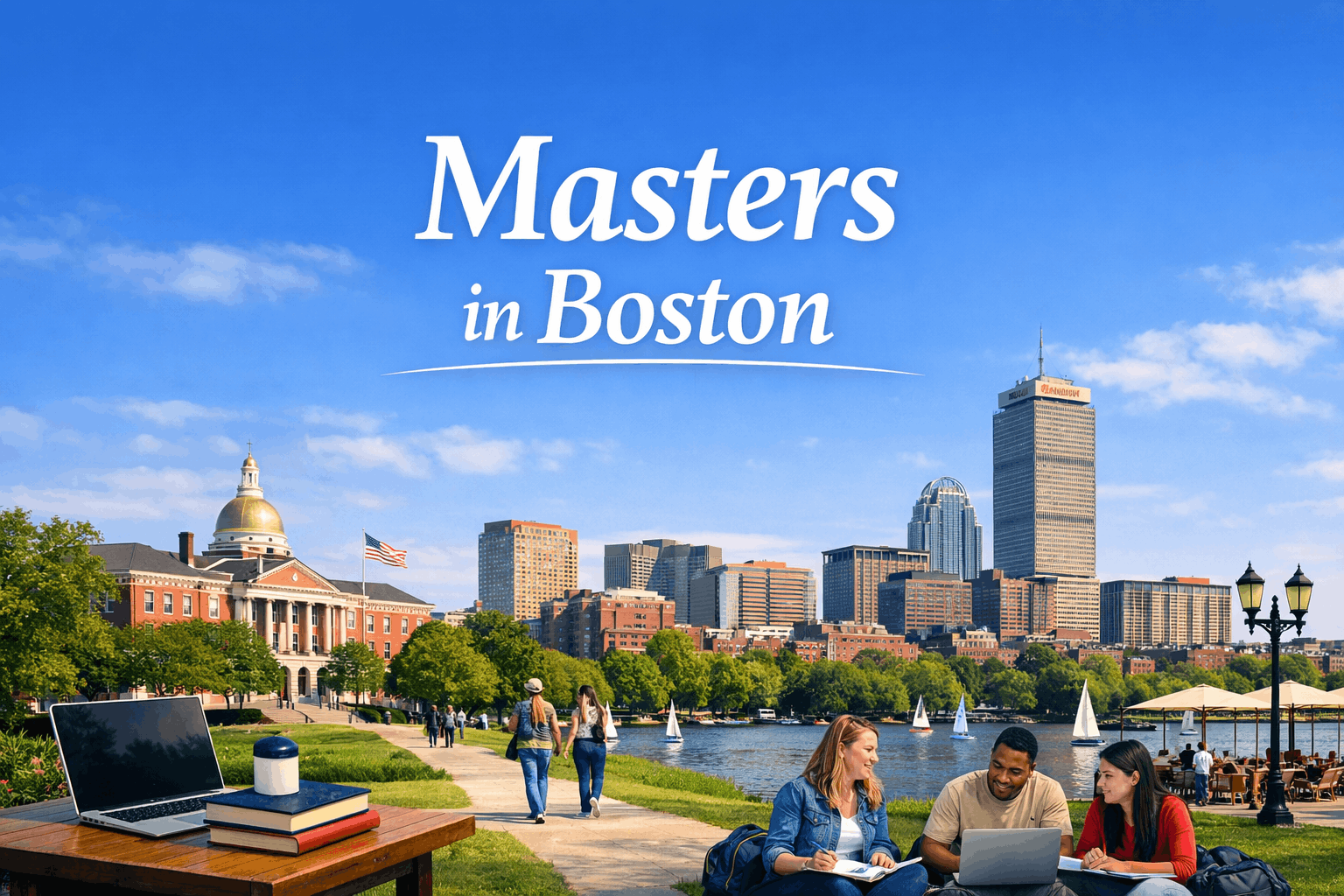
Masters in Boston
Table of Contents
- Why Study Masters in Boston?
- Top Universities in Boston for Masters
- Best Courses to Study Masters in Boston
- Eligibility and Admission Requirements to Study Masters in Boston
- Cost of Study in Boston
- Top Scholarships to Study Masters in Boston
- Intakes and Application Timeline for Study in Boston
- How to Apply to Study Masters in Boston
- Student Visa Requirements for Masters in Boston
- Work Opportunities While Studying Masters in Boston
- Job Opportunity in USA After Studying Masters in Boston
- Author's POV
Pursuing a Masters in Boston gives students the opportunity to study in one of the world's most respected academic and research destinations. Home to more than 100 colleges and universities and over 350,000 students, Boston offers a dynamic environment that combines high-quality education with excellent career opportunities. From engineering and business to public health, data science, and finance, students can choose from a wide range of specialised master's programmes.
Universities such as Boston University, along with several other globally recognised institutions, provide flexible study options, industry connections, and research opportunities, making Masters in Boston an excellent choice for students seeking academic excellence and long-term career growth.
Key Highlights of Masters in Boston:
Key Highlights | Details |
Top Universities | MIT, Harvard University, Boston University, Boston College |
Course Duration | 1 to 2 years postgraduate |
Popular Fields | Business Analytics, Finance, Accounting, Cybersecurity, Clinical Research, Economics, Artificial Intelligence |
Tuition Fees | USD 37,520–89,166 (approx. INR 35.7L–84.9L) |
Living Expenses | USD 17,870–21,105/year (approx. INR 17.0L–20.1L) |
Post-Study Work Option | OPT (12 months) + STEM OPT (24 months, if applicable) |
Language of Instruction | English |
Why Study Masters in Boston?
Boston is genuinely unlike most other US study destinations, since the sheer density of top-ranked universities within one metro area creates a job market and academic culture built specifically around graduate-level talent. Choosing a Masters in Boston means studying in a city where higher education is one of the largest employers in its own right.
1. Two Globally Elite Universities Within 10 Miles: MIT ranks #1 and Harvard ranks #5 in the QS World University Rankings 2027, giving Boston a concentration of world-leading research institutions that few other cities can match.
2. A Dense Biotech and Finance Corridor: Boston is home to major biotech, pharmaceutical, and financial services firms including Fidelity Investments, State Street, and Thermo Fisher Scientific, all of which actively recruit from the city's graduate talent pool.
3. Genuine Range in Cost and Selectivity: Beyond MIT and Harvard, Boston University and Boston College offer considerably more accessible tuition and admission standards without leaving the same city's employer network.
4. A Recognised NSA Centre of Excellence: Boston University holds recognition from the National Security Agency as a Center of Academic Excellence in Cyber Defense and Research, a genuinely significant credential for cybersecurity-focused students.
5. Strong STEM and Analytics Pipeline: With STEM-designated programmes across data analytics, computer information systems, and business analytics, many Boston master's degrees qualify graduates for extended STEM OPT work authorisation.
6. Post-Study Work Access: International graduates can apply for Optional Practical Training (OPT), extended to 24 additional months for STEM-designated degrees, common across Boston's analytics and technology programmes.
Top Universities in Boston for Masters
Universities in Boston for Masters split into two clear tiers: two globally elite, extremely selective research universities, and a second tier of considerably more accessible institutions offering strong, career-focused programmes within the same city.
University | QS World Ranking 2027 | Known For |
Massachusetts Institute of Technology (MIT) | #1 globally | Engineering, Computer Science, Economics |
Harvard University | #5 globally | Business, Law, Medicine, Public Policy |
Boston University | #81 globally | Business Analytics, Finance, Cybersecurity, Clinical Research |
Northeastern University | #=385 globally | Co-op programmes, Business, Computer Science |
Boston College | #=549 globally | Economics, Accounting, Finance |
Best Courses to Study Masters in Boston
Boston is home to some of the world's leading universities, making it an excellent destination for postgraduate study. Students can choose from a wide range of master's programmes in business, technology, healthcare, finance, and economics, with many courses offering industry partnerships, research opportunities, and practical learning. Below are some of the most sought-after master's programmes available at universities in Boston.
1. Master in Business Analytics at Boston University
The Master in Business Analytics at Boston University is offered through the Questrom School of Business. It equips students with the analytical and technical skills needed to solve complex business problems using data. Students can choose between an accelerated 12-month programme or a 16-month option that includes additional experiential learning.
Particulars | Details |
University | Boston University |
Duration | 12 or 16 months |
Tuition Fees | Approx. INR 75.8 lakh (USD 89,166–89,271) |
Key Learning Areas | Business Analytics, Data Visualisation, Machine Learning, Business Intelligence |
Career Opportunities | Business Analyst, Data Analyst, Analytics Consultant, Product Analyst |
2. Master in Finance at Boston University
The Master in Finance at Boston University prepares students for careers in investment banking, corporate finance, fintech, and asset management. The curriculum combines financial theory with practical applications to help students understand today's global financial markets.
Particulars | Details |
University | Boston University |
Duration | 12–16 months |
Tuition Fees | Approx. INR 59.4 lakh/year (USD 69,870) |
Key Learning Areas | Corporate Finance, Investments, Financial Modelling, Risk Management |
Career Opportunities | Financial Analyst, Investment Analyst, Risk Analyst, Portfolio Manager |
3. Master in Accounting at Boston University
The Master in Accounting at Boston University is designed for students who want to build expertise in auditing, taxation, financial reporting, and accounting analytics. The programme also supports students preparing for professional accounting certifications.
Particulars | Details |
University | Boston University |
Duration | 12 months |
Tuition Fees | Approx. INR 59.4 lakh/year (USD 69,870) |
Key Learning Areas | Auditing, Taxation, Financial Reporting, Accounting Analytics |
Career Opportunities | Auditor, Tax Consultant, Financial Accountant, Accounting Manager |
4. Master in Computer Information Systems at Boston University
The Master in Computer Information Systems at Boston University combines technical knowledge with business management, preparing students for leadership roles in information technology. Flexible study options allow students to learn online, on campus, or through a blended format.
Particulars | Details |
University | Boston University |
Study Mode | Online, On-campus & Hybrid |
Tuition Fees | Charged on a per-credit or semester basis |
Key Learning Areas | Cloud Computing, Database Management, Enterprise Systems, IT Strategy |
Career Opportunities | Systems Analyst, IT Consultant, Solutions Architect, Technology Manager |
5. Master in Cyber Security at Boston University
The Master in Cyber Security at Boston University develops the technical and strategic skills required to protect organisations against evolving cyber threats. The programme includes advanced coursework in digital forensics, network security, ethical hacking, and information assurance.
Particulars | Details |
University | Boston University |
Study Mode | Online, On-campus & Hybrid |
Tuition Fees | Charged on a per-credit or semester basis |
Key Learning Areas | Cyber Defence, Digital Forensics, Network Security, Information Assurance |
Career Opportunities | Cybersecurity Analyst, Security Engineer, Information Security Manager, Cyber Consultant |
6. Master in Artificial Intelligence at Boston University
The Master in Artificial Intelligence at Boston University focuses on artificial intelligence, machine learning, and intelligent systems that are shaping industries worldwide. Students gain both theoretical knowledge and practical experience through project-based learning.
Particulars | Details |
University | Boston University |
Tuition Fees | Approx. INR 15.9 lakh (USD 18,750)* |
Key Learning Areas | Artificial Intelligence, Machine Learning, Deep Learning, Data Analytics |
Career Opportunities | AI Engineer, Machine Learning Engineer, Data Scientist, AI Consultant |
7. Master in Clinical Research at Boston University
The Master in Clinical Research at Boston University prepares students to contribute to medical discoveries and healthcare innovation. The programme develops expertise in clinical trials, research ethics, biostatistics, and regulatory compliance, making it suitable for careers in hospitals, pharmaceutical companies, and research organisations.
Particulars | Details |
University | Boston University |
Programme Focus | Clinical Research |
Key Learning Areas | Clinical Trials, Biomedical Research, Research Design, Regulatory Affairs |
Career Opportunities | Clinical Research Associate, Medical Researcher, Clinical Trial Manager, Regulatory Affairs Specialist |
8. Master in Economics at Boston College
The Master in Economics at Boston College provides rigorous training in economic theory, econometrics, and policy analysis. Students develop strong analytical and quantitative skills that prepare them for careers in finance, consulting, public policy, international organisations, and academic research.
Particulars | Details |
University | Boston College |
Tuition Fees | Approx. INR 1.9 lakh per credit (USD 2,248 per credit) |
Key Learning Areas | Econometrics, Macroeconomics, Microeconomics, Public Policy |
Career Opportunities | Economist, Policy Analyst, Financial Analyst, Research Consultant |
Eligibility and Admission Requirements to Study Masters in Boston
Admission requirements across Boston's universities vary sharply by selectivity tier, from MIT and Harvard's extremely competitive process to Boston University and Boston College's more standard graduate admissions framework.
Academic Requirements
Most Boston master's programmes require a recognised bachelor's degree, with GPA expectations and standardised test requirements varying by specific programme.
Institution Tier | Minimum Academic Requirement | Key Notes |
Highly Selective (MIT, Harvard) | Exceptional GPA, competitive research or professional profile | Extremely selective; strong standardised test scores expected |
Boston University (most programmes) | GPA around 3.0/4.0 | GRE/GMAT optional for several programmes, including MSBA |
Boston College | Standard graduate GPA requirements | Varies by graduate division |
English Language Requirements
International applicants whose first language isn't English must submit an approved test score, with Boston University's MSBA programme offering a useful representative benchmark.
Test | Minimum Score (BU MSBA, representative) |
IELTS Academic | 6.5 |
TOEFL iBT | Equivalent standard required |
Duolingo English Test | 120 |
Cost of Study in Boston
The total cost of a Masters in Boston comes down to tuition, which varies enormously between MIT-tier institutions and more accessible programmes, alongside Boston's genuinely high cost of living.
Tuition Fees at Boston Universities
University | Programme Type | Approx. Annual Tuition (USD/INR) |
Boston University | Graduate School (General) | USD 67,626-71,168 (INR 64.4L-67.8L) |
Boston University | Questrom Specialty Master's | USD 69,870 (INR 66.5L) |
Boston University | MSBA (12-Month, Total Programme) | USD 89,166 (INR 84.9L) |
Boston College | Graduate School (General) | USD 37,520 (INR 35.7L) |
Cost of Living in Boston
Boston consistently ranks among the most expensive US cities, and Numbeo's most recent data, updated in July 2026, confirms this remains true, running roughly 48 percent above the national average.
Expense Category | Estimated Monthly Cost (USD) | INR Equivalent |
Cost of living, single person, excluding rent | USD 1,489.20 | INR 1.42 lakh |
Basic Utilities | USD 229.04 | INR 21,800 |
Meal at Low-Cost Restaurant | USD 25 | INR 2,380 |
Health Costs (single resident, annual) | USD 3,911 | INR 3.72 lakh |
Source: Numbeo
Hence, Approximate Annual Living Cost: USD 17,870-21,105 (approx. INR 17.0L-20.1L), depending on housing choice and lifestyle.
Top Scholarships to Study Masters in Boston
Pursuing a master's degree in Boston is a significant investment, but scholarships and funding opportunities can help reduce the overall cost. Universities in Boston offer a mix of merit-based scholarships, fellowships, and assistantships for graduate students.
While some awards are automatically considered during the admission process, others have programme-specific eligibility requirements. Applying early and maintaining a strong academic profile can improve your chances of receiving financial support.
Scholarship | Coverage | Eligibility |
Boston University Graduate Merit Scholarships | Partial tuition scholarships awarded to help reduce the cost of eligible master's programmes. | Students with a strong academic record applying to eligible graduate programmes. Most applicants are automatically considered during admission. |
Boston University Graduate Fellowships | May provide tuition support, research funding, or a living stipend, depending on the department. | Graduate students admitted to eligible programmes who meet departmental academic and research requirements. |
Teaching & Research Assistantships | Financial support through tuition assistance and/or a monthly stipend in exchange for teaching or research responsibilities. | Students enrolled in research-focused graduate programmes with strong academic or research potential. |
Boston College Graduate Financial Aid | Need-based financial assistance to help cover tuition and educational expenses. | Eligible graduate students who demonstrate financial need and satisfy the university's financial aid criteria. |
Departmental Scholarships | Merit-based awards offered by individual schools and academic departments. | Students who meet the academic or programme-specific requirements established by the respective department. |
Intakes and Application Timeline for Study in Boston
Boston's universities generally follow the standard US academic calendar, with Fall as the primary intake, though several specialty master's programmes at BU also offer Spring entry.
Intake | Programme Start | Application Timeline |
Fall Intake (Main) | August/September | Applications typically open 8-12 months prior; BU MSBA deadline around 16 March 2026 for Fall entry |
Spring Intake (Select Programmes) | January | Available at select BU specialty master's programmes |
Note: Fall remains the primary and most practical entry point for a Masters in Boston, offering the widest programme selection and the strongest scholarship consideration alongside your standard admissions application.
How to Apply to Study Masters in Boston
Applying for a Masters in Boston is straightforward but requires good organisation, since document preparation, standardised testing, and visa processing all need to happen within a defined window.
Step | What to Do |
Step 1: Shortlist Universities | Compare MIT, Harvard, Boston University, and Boston College based on programme, tuition, and admission competitiveness |
Step 2: Check Eligibility | Review GPA requirements, English test minimums, and GRE/GMAT policies for your specific programme |
Step 3: Prepare Language Tests | Sit IELTS, TOEFL, or Duolingo well ahead of your application deadline |
Step 4: Compile Documents | Gather transcripts, resume, three video essays (for BU MSBA), and letters of recommendation |
Step 5: Submit Application | Apply through each university's official admissions portal; pay application fees |
Step 6: Apply for Scholarships | Submit alongside or immediately after your admissions application, since most are automatically considered |
Step 7: Accept Offer | Confirm your place by accepting the offer and paying any required deposit |
Step 8: Receive Form I-20 and Apply for F-1 Visa | Once financial proof is confirmed, your university issues Form I-20 to begin your visa application |
Step 9: Arrange Pre-Departure | Book accommodation, organise health insurance, and prepare travel documents |
Student Visa Requirements for Masters in Boston
To study a Masters at any Boston-area university full-time, international students need an F-1 Student Visa. The process starts once you have your I-20 from the university's international student office.
Eligibility Criteria:
Confirmed admission from a SEVP-approved Boston university
Valid Form I-20 issued by the university's international student office
Demonstrated English language proficiency through an accepted test
Sufficient financial resources to cover tuition and living costs for at least one full academic year
Genuine intent to complete the programme and comply with F-1 visa conditions
Financial Requirements:
Students must show funds covering at least the first full year of study, including tuition and living costs, as stated on the I-20. The 28-day rule applies: funds must be clearly visible in your bank account for at least 28 consecutive days before your visa interview date.
Documents Required for F-1 Visa:
Valid passport (minimum 6 months validity beyond intended stay)
Form I-20 issued by the university's international student office
DS-160 confirmation page
SEVIS fee receipt (USD 350 (approx. INR 33,700) paid at FMJfee.com)
Visa appointment confirmation
Academic transcripts, degree certificates, and foreign credential evaluation report
GMAT or GRE score report (if required)
English language proficiency certificate (TOEFL, IELTS, PTE, or Duolingo)
Financial proof (bank statements, education loan letter, or sponsor affidavit)
Passport-size photographs per US visa specifications
Work Opportunities While Studying Masters in Boston
International students on an F-1 visa can work on campus for up to 20 hours per week during the academic term, and full-time during scheduled breaks, without needing separate authorisation.
Role | Work Limit | Approx. Hourly Rate |
Graduate Teaching Assistant | Up to 20 hours/week during academic term | USD 22–30/hour (Approx. INR 1,900–2,600/hour) |
Research Assistant | Up to 20 hours/week during academic term | USD 20–27/hour (Approx. INR 1,700–2,300/hour) |
Campus or Administrative Support | Up to 20 hours/week during academic term | USD 15–20/hour (Approx. INR 1,300–1,700/hour) |
Tech/Analytics Internship (CPT) | Programme-specific; often full-time | USD 25–45/hour (Approx. INR 2,100–3,900/hour) |
Note: Most BU graduate students take on 10-15 hours of part-time work per week to maintain academic performance and financial aid status, and international students not eligible for federal work-study can still access on-campus employment under standard visa regulations.
Job Opportunity in USA After Studying Masters in Boston
Job opportunities after a Masters in Boston are concentrated in financial services, biotech, information technology, and management consulting, consistently ranking Boston Consulting Group, Fidelity Investments, and Thermo Fisher Scientific among the top-paying local employers.
Top Job Roles and Salary Ranges in Boston, MA:
Job Role | Approx. Annual Salary (USD) | INR Value |
Data Scientist | USD 131,707-165,942 | Rs. 1.25Cr-1.58Cr |
Financial Analyst | USD 72,627-114,585 | Rs. 69.1L-109.1L |
Senior Financial Analyst | USD 114,184-156,918 | Rs. 108.7L-149.4L |
Data Analyst | USD 95,998 (average) | Rs. 91.4L |
Accountant | USD 78,035-219,790 | Rs. 74.3L-209.2L |
Cybersecurity Analyst (Entry Level) | USD 74,500-95,000 | Rs. 70.9L-90.5L |
Financial Accountant | USD 88,493-140,877 | Rs. 84.3L-134.1L |
Source: Glassdoor
Author's POV
A Masters in Boston offers far more than a globally recognised degree. It places you in one of the world's strongest education and employment hubs, where leading universities work closely with industries in technology, finance, healthcare, and research. While tuition fees and living costs are higher than in many US cities, the long-term career opportunities often justify the investment.
Graduates benefit from access to internships, research projects, professional networking, and employers that actively recruit talent from Boston universities. The key is choosing a programme that matches your career goals rather than focusing only on university rankings. With careful financial planning, scholarship opportunities, and a clear post-graduation strategy, studying for a master's degree in Boston can provide excellent academic value and strong long-term career returns.
Connect with experts to book a free 1:1 session to explore course options, career pathways, and more.